Complete credit repair training and Board Certified Credit Consultant certification covering the FCRA, the FDCPA, the Telemarketing Sales Rule, Metro 2 reporting, and pre-litigation strategy. Written for professionals who need to know where the legal lines actually are.
Programs start at $97 · Self-paced & online · Exam and certification fees included
Most of our members were already dealing with credit problems before they came to us. They just weren't getting paid for it, or weren't sure they were doing it correctly.
Loan officers, brokers, and agents who walk borrowers through credit issues on nearly every deal — usually unpaid, and often without knowing where the compensation rules apply.
Practices adding credit services to existing client work, where the governing statutes matter more than the sales pitch.
Owners training staff to a common standard — particularly those getting frivolous-dispute responses from the bureaus and wanting to understand why.
People entering credit services who want the complete picture: the laws, the dispute process, client intake, contracts, and how to structure a compliant practice from day one.
Every plan includes training materials, exam and certification fees, twelve months of association membership, and helpdesk access. There is no upsell to software you must buy to use the training.
BCCC certification · digital
BCCC + CCSC · digital
Full credential track
Printed manuals and additional credential packages are available. Membership renews at $29 per year. Compare all programs →
Training and credentials for people who do credit work professionally.
A credit report decides more than an interest rate. It affects mortgage approval, auto financing, rental applications, insurance pricing in most states, and — for certain positions, particularly those handling money — whether an applicant clears a background screening.
Errors in those files are common. The Federal Trade Commission's study of credit report accuracy found that roughly one in five consumers had a verified error on at least one of their three reports, and about one in twenty had errors serious enough to change the credit terms they were offered. Duplicate collections, incorrect dates of first delinquency, balances that never updated, accounts that don't belong to the consumer at all — these are ordinary findings, not rare ones.
Is credit repair legal? Yes. The Fair Credit Reporting Act gives every consumer the right to dispute inaccurate, incomplete, or unverifiable information, and the right to have someone assist them. The work is lawful. The Credit Repair Organizations Act, the Telemarketing Sales Rule, and a number of state statutes govern how those services can be sold and when a consultant can be paid. Knowing those rules is not optional, and it is the first thing we teach.
Does the industry have a reputation problem? Yes — and we're not going to pretend otherwise. Enforcement actions against credit repair firms are still being brought. The reputation this field carries was earned by companies that took money up front, filed template disputes by the thousand, and delivered nothing. That is precisely why a trade association like ours exists.
We agree with it, and we say so plainly: most credit information is freely available, and there is very little a credit repair firm can do that a consumer couldn't do themselves with the right knowledge. We tell consumers that directly.
It's also true that accurate, timely, verifiable information cannot be legally removed from a credit report. We teach that as a rule, not a loophole.
But that statement gets repeated as if it settles the matter, and it doesn't. It says nothing about the incomplete entries, the duplicate collections, the wrong dates of first delinquency, the accounts a furnisher can't actually substantiate, or the scoring factors a consumer is free to change tomorrow. Doing that work properly means knowing the FCRA, the FDCPA, Metro 2 reporting, and where the compensation rules apply.
There's a learning curve, and many consumers need help now rather than after six months of research. A consumer who reads a forum thread, sends a letter they don't fully understand, and triggers a frivolous-dispute response from the bureau is often worse positioned than when they started. Paying a qualified professional for clarity is a reasonable choice — the same choice people make with tax preparers and attorneys every day.
Mortgage brokers, loan officers, and real estate agents already resolve credit problems for clients constantly — usually unpaid, informally, and without knowing where the legal lines sit. A large share of our members came from exactly those fields, added a credential, and started treating credit work as a billable service rather than a favor. Attorneys, tax preparers, and bookkeepers are in a similar position, adding credit services to an existing practice. Established credit service companies run their staff through our certification to make sure everyone is working to the same standard. And people entering the field get the complete picture from the beginning.
We don't publish income projections. Fees vary widely by market, service model, and how you structure your business, and anyone quoting you a monthly figure is guessing. What we can tell you is exactly what the training covers, what it costs, and what the credential means.
CCA is a self-regulating trade association. Certified members agree to a published ethics code and a consumer-conscious policy: honest fees for honest work, no misrepresentation of what can and cannot be achieved, and no charging for services not rendered. We maintain a complaint center for consumers who believe a certified member has fallen short of that standard, and we act on what comes in.
Certification is what puts you in the directory consumers search, and it's what tells a prospective client you're working to a standard someone else is enforcing.
Starting a credit repair business is less about finding clients than about getting the foundation right before the first one arrives — the mistakes made in the first ninety days are the expensive ones. Learn the four statutes that govern the work, check whether your state requires registration or a surety bond, put compliant contracts and disclosures in place, and understand the dispute process properly before you take anyone's money. Software comes last, not first.
We've written the full walkthrough: each law with its citation and what it actually requires, the paperwork CROA mandates, the client workflow from consultation to escalation, and the six mistakes that close businesses. Read the complete guide →
Our self-study materials cover each of these in depth and prepare you for the certification exam. You can review the full course topics before enrolling.
Credit repair software is useful once you have volume to manage. It is not a substitute for knowing the work. We recommend learning the process first and choosing software second — and we suggest several low-cost options rather than selling you one. Several established credit repair companies also run their own employees through our certification to make sure everyone is trained to the same standard.
A plain-language walkthrough of the five laws that govern credit services work — what each one requires, where consultants most often get it wrong, and the questions to ask before you take a client's money.
Sent by email as a PDF. Written by the same people who write the certification training.
Something went wrong. Please check your email address and try again.
We'll email you the guide plus occasional updates on credit industry rule changes. Unsubscribe any time. We don't sell or share your address.
I'm a real estate investor and many of the people I see have tremendous credit issues. I purchased the digital program and printed the material myself. It was everything I needed to turn credit-challenged clients into paying customers. The helpdesk keeps you abreast of pending changes in the industry.
Having an MBA and a law degree gives me some perspective on the structure of information. CCA's program provides the exact process, forms, letters, and credentials without investing tons of cash. We'd added credit services through another organization and something was missing — basically we were paying to learn a software program.
My business partner paid thousands to get certified elsewhere, but mostly what he learned was how to use the software they were selling. We kept getting frivolous-dispute letters from the bureaus. Here he was taught actual techniques and strategy. Get the training first and buy software later if you need it.
I searched the internet for a credit repair training program and there are many. I purchased three of them, paying over $3,500, and did not feel comfortable with my knowledge until I got this program with the helpdesk included. The price is a real value for the tactical information received.
I recently passed the Illinois bar and was looking to add credit repair to my practice. I first landed on a program offering one-on-one phone training and software, but it wasn't thorough. When I looked at CCA's training I signed up. I went to the helpdesk before I'd even finished the manual and it answered all my questions.
My husband attended a seminar and came back saying we needed to purchase additional resources to look more professional. When my sister looked at the Credit Consultants Association program we both realized we didn't need any of it. You don't need to spend a lot of money to look professional — you need to know the work.
I needed solid information on how to start a credit repair business and on the credit process itself. Your team is excellent. I wish I'd found you before paying $5,700 for another training that doesn't come close to what you offer.
Testimonials reflect the individual experiences of these members and are not a guarantee or prediction of the results any other member will obtain. Outcomes depend on individual effort, market, and how a practice is operated. CCA does not represent that any particular income or business result is typical.
No. No state requires a credit repair certification, and our credential is not a government license. What is required is compliance with federal and state law. Certification demonstrates that you've been trained to a published standard and agree to an enforceable code of ethics — which is increasingly what clients ask about.
The Board Certified Credit Consultant (BCCC) is the core certification covering the governing laws, the dispute process, and running a compliant practice. The Certified Credit Score Consultant (CCSC) is a supplemental credential that goes deeper into FICO and credit scoring. The CCSC requires the BCCC first.
No. Software helps manage volume once a practice grows, but it can't think for you and it doesn't pull credit reports. We recommend learning the work manually first and selecting software afterward. We don't sell software as part of certification.
The training is self-paced; most members finish the Standard program in about twenty hours. The BCCC exam is 80 multiple-choice questions with a 90-minute limit and a 75% passing score, taken online. Results are immediate and four attempts are included. The course and exam should be completed within one year of purchase.
Membership renews at $29 per year. That maintains your directory listing, helpdesk access, and use of the credential mark.
Yes, and they vary. Several states impose registration, bonding, or contract requirements on credit services organizations, and at least one restricts the activity substantially. The training covers the federal framework and points you to state-level requirements, but we are not a law firm — confirm your own state's rules with counsel before taking clients.
See our terms and policies for full refund terms.
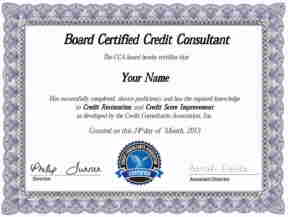
Search the public directory of Board Certified Credit Consultants and Certified Credit Score Consultants.
Search the directory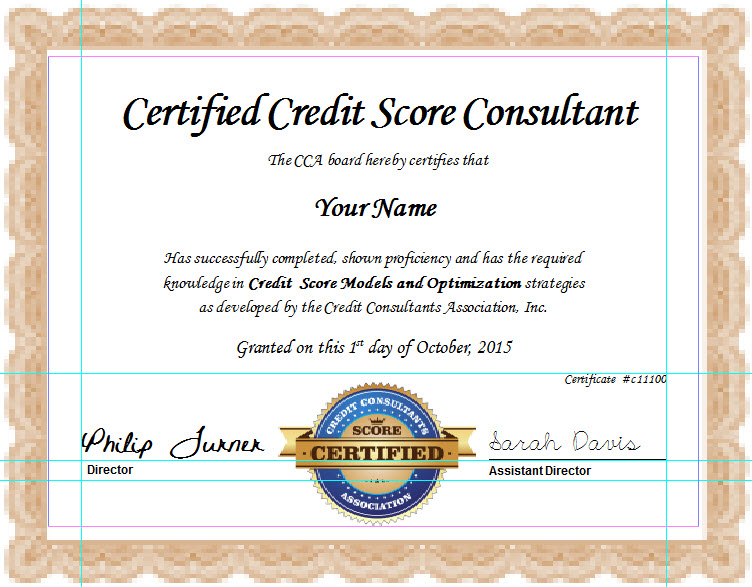
Access your dashboard, training materials, exams, and the Consultant Helpdesk.
Member log-in Legacy members
Training, credentials, and ongoing helpdesk support to build a credit practice that holds up to scrutiny. Programs start at $97.
View Programs & PricingMembers in good standing may display the CCA seal on their website and materials. Each seal links to that member's listing in the public directory so clients can verify it independently.
